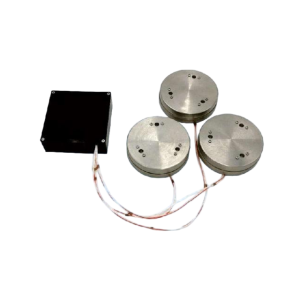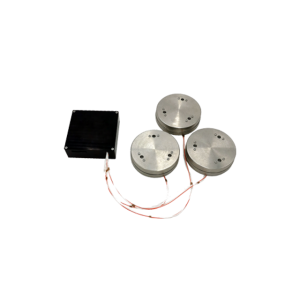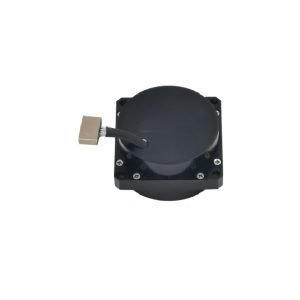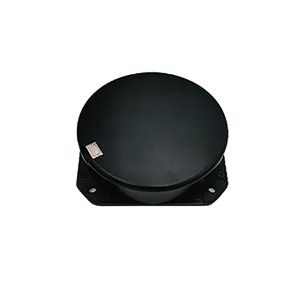
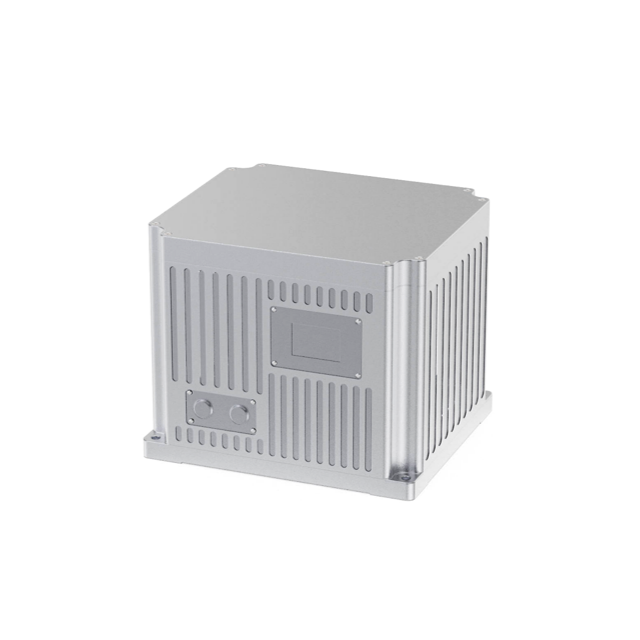
The North Seeker primarily consists of several key components, including a fiber optic gyroscope, an accelerometer circuit, a rotation structure control circuit, a processor calculation circuit, and a power conversion circuit. Specifically, this north-finding device is based on the Sagnac effect and utilizes optical fibers to form a circular optical path. By doing so, it can measure the optical path differences caused by the rotation of the fiber ring on two beams of light, thereby obtaining angular increment information along the sensitive axis and accurately determining the Earth’s rotational angular velocity.
During operation, the rotating structure measures the Earth’s rotational angular velocity components at three different positions. Subsequently, the orientation information of the product calculates based on the measured components of the Earth’s rotational angular velocity. In addition, dual-axis accelerometers are employed to obtain tilt angle data of the product’s axes. This data, in turn, can be used for platform calibration as well as for tilt correction of the North Seeker, ensuring precise north-finding performance.
Specifications
| Power supply | |
| Power supply voltage | 9-36VDC |
| Peak power consumption | ≤12W |
| Main Technical Indicators | |
| Operation mode | Static |
| Preparation time | ≤30s |
| North seeking time | ≤3min |
| Measuring range of transverse and longitudinal inclination angles | -15º~+15º |
| Inclination accuracy | ≤0.02º (1σ) |
| North seeking accuracy | ≤0.06º and 0.1º optional (1) |
| Azimuth angle measuring range | 0º-360º |
| Working latitude (design guarantee) | 65ºS~65ºN |
| Altitude | >4500 meters |
| Digital output form | RS-422. Optional RS-232, RS-485, CAN |
| Weight | ≤3.5Kg |
| Communication protocol | customizable |
Digital communication uses differential RS-422 asynchronous serial full-duplex communication.
Serial communication takes one byte as the basic transmission unit, with a baud rate of 38400bps, and then one byte transmission has 10 valid bits: 1 start bit (logical 0), 8 data bits, no parity check, 1 stop bit (logical 1). In the 8-bit data, the low bit is first, and the high bit is last; for a multi-byte number, the low byte transmits first, then by the high byte.
| Environmental Conditions | |
| Operating temperature range | -40℃~+70℃ |
| Storage temperature range | -55℃~+70℃ |
| Shock | 10g, 11ms, half-sine wave, direction: installation direction, number of times: 3 times |
| Vibration | 5Hz~5.5Hz, 25.4mm; 5.5Hz~200Hz, 1.5g (rms); direction: installation direction; time: 15min; number of cycles: 3 times |
| Wet heat | Under conditions of 30℃ and 60℃, with a relative humidity of (95±3)%, it should work normally, with no rust on metal surfaces, and no blistering, wrinkling, cracking, or peeling of the protective coating |
| Rain | Rain intensity: 13cm/h, rain time: 1h, rain angle: four sides and top, nozzle diameter: 1mm~2mm |
Applications
- Accurately determine the true north direction of the construction site
- True North Reference in Mining Exploration
- Ship heading reference
- Tactical positioning and navigation system