
Introduction
Inertial Measurement Units (IMUs) are essential components in modern engineering systems, enabling accurate motion tracking, navigation, and stabilization. From robotics and drones to industrial automation, choosing the right IMU sensor can significantly impact system performance.
However, selecting an IMU is not just about specifications — it requires understanding your application, environment, and performance requirements.
This guide will help you choose the right IMU sensor based on real engineering needs.
I. What is an IMU Sensor?
An IMU (Inertial Measurement Unit) combines multiple sensors to measure motion and orientation. Typically, it includes:
- Accelerometers (measure linear acceleration)
- Gyroscopes (measure angular velocity)
- Sometimes magnetometers (for heading reference)
IMUs are widely used in:
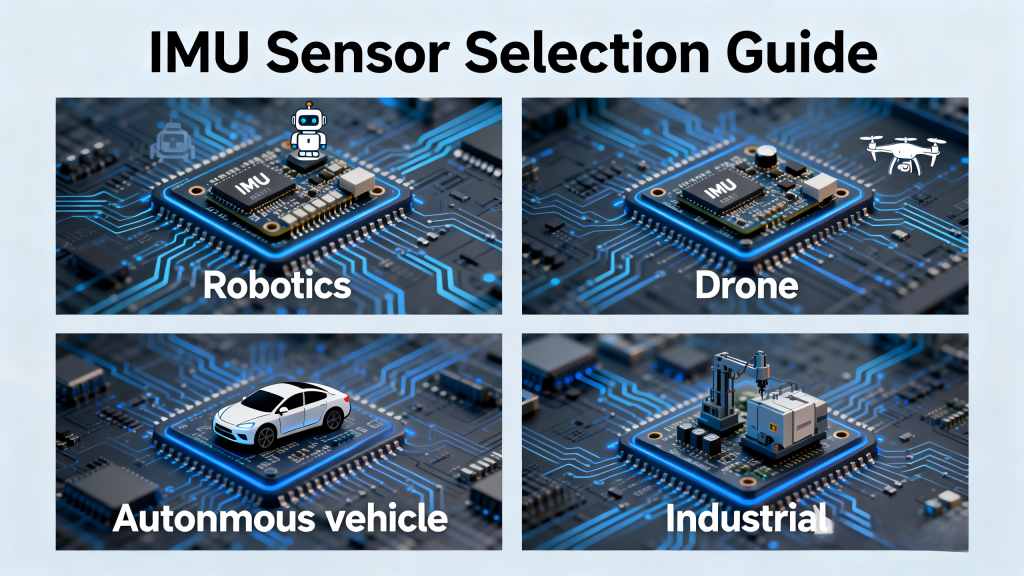
- Robotics
- Drones and UAVs
- Autonomous vehicles
- Industrial equipment
II. Key Factors When Choosing an IMU
1. Accuracy and Drift
Accuracy determines how precise your measurements are, while drift refers to accumulated error over time.
- Low-cost MEMS IMUs → higher drift
- High-end IMUs → better stability
☛ For navigation systems, low drift is critical.
2. Application Environment
Consider where your sensor will operate:
- High vibration (industrial machinery)
- Temperature variations
- Outdoor / harsh environments
☛ Industrial environments require robust and stable sensors.
3. Size and Power Consumption
For compact systems like drones or portable devices:
- Small size is essential
- Low power consumption extends battery life
☛ MEMS IMUs are ideal for size-constrained applications.
4. Interface and Integration
Check compatibility with your system:
- Analog / SPI / I2C output
- Ease of integration
- Software support
☛ Easy integration can significantly reduce development time.
5. Cost vs Performance
There is always a trade-off:
- Low-cost IMUs → suitable for consumer applications
- High-performance IMUs → required for industrial or navigation systems
☛ Choose based on actual requirements, not over-specification.
III. IMU Selection by Application
Robotics
- Moderate to high accuracy
- Real-time response
- Stable performance
☛ Recommended: Mid-to-high performance MEMS IMUs
Drones / UAVs
- Lightweight
- Low power
- Fast response
☛ Recommended: Compact MEMS IMUs
Autonomous Navigation
- Very low drift
- High reliability
☛ Recommended: High-performance IMUs or FOG-based systems
Industrial Automation
- Strong anti-interference
- Stable under vibration
☛ Recommended: Industrial-grade IMUs
IV. Common Mistakes to Avoid
Many engineers make these mistakes:
- Choosing based only on price
- Ignoring drift performance
- Overlooking environmental factors
- Selecting overly complex sensors
☛ The best IMU is the one that fits your actual application.
Learn more about our IMU sensors
V. How HXGYRO Can Help
At HXGYRO, we provide a range of IMU solutions for different applications, including:
- MEMS-based IMUs for compact systems
- High-stability sensors for industrial use
- Custom solutions based on project requirements
We focus on:
- Accuracy
- Stability
- Easy integration
Conclusion
Choosing the right IMU sensor requires balancing accuracy, environment, size, and cost.
By understanding your application needs, you can select a sensor that delivers reliable and consistent performance.
☏ Call to Action
Not sure which IMU is right for your project?
Contact us today to discuss your requirements — we’ll help you find the best solution.
Contact us for custom solutions
WhatsApp: +86-18590922509
Facebook: hxgyro
LinkedIn: HuaXi Technology (Xi’an) Co., Ltd.