
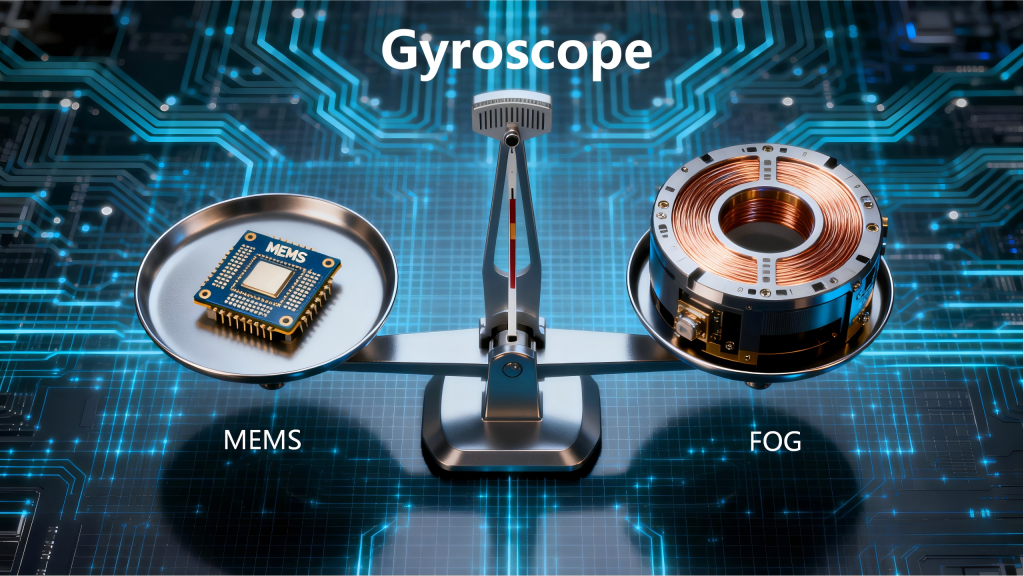
Inertial navigation relies on gyroscopes to measure angular velocity and orientation. Two common technologies dominate the market: MEMS gyroscopes and Fiber Optic Gyroscopes (FOG). Choosing the right sensor depends on your application requirements.
1️⃣ MEMS Gyroscopes
Advantages:
- Compact and lightweight
- Low cost
- Low power consumption
- Easy to integrate in electronics
Limitations:
- Moderate accuracy
- Higher drift over time
- Sensitive to temperature variations
Best suited for:
- Consumer electronics
- Drones and UAVs
- Robotics requiring moderate precision
2️⃣ FOG Gyro
Advantages:
- Extremely high precision
- Very low drift
- Reliable in harsh environments
Limitations:
- Larger size
- Higher cost
- Requires more complex integration
Best suited for:
- Industrial navigation systems
- Autonomous vehicles
- Aerospace applications
3️⃣ Key Considerations When Choosing
| Feature | MEMS Gyro | FOG Gyro |
|---|---|---|
| Accuracy | Medium | High |
| Drift | Moderate | Very Low |
| Size / Weight | Small / Light | Larger |
| Cost | Low | High |
| Integration Complexity | Easy | Medium |
| Harsh Environment Use | Limited | Excellent |
Conclusion:
For cost-sensitive, compact applications, MEMS gyros are ideal. For high-precision, industrial or aerospace systems, FOG gyros remain the preferred choice.
At HXGYRO, we offer both MEMS and FOG gyroscopes, allowing you to choose the optimal solution for your project. Our team can help you evaluate your application requirements and select the right sensor.
💬 Interested in learning which gyroscope fits your project? Contact us for a consultation.
Please select a form