
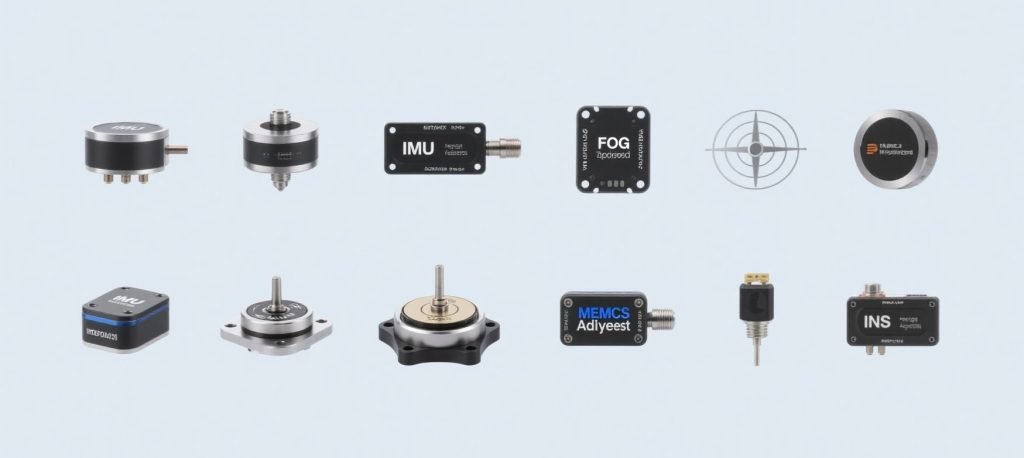
In modern automation systems, the stable operation of unmanned platforms relies on continuous perception of the environment and their own states. The Inertial Measurement Unit (IMU) is one of the components that plays a pivotal role in this core task. Whether it’s Unmanned Aerial Vehicles (UAVs), Automated Guided Vehicles (AGVs), or Autonomous Underwater Vehicles (AUVs), they all rely on the precise navigation and attitude sensing capabilities of IMUs.
What is IMU?
IMU stands for Inertial Measurement Unit, typically consisting of accelerometers and gyroscopes in multiple axes. Its primary function is to measure the acceleration, angular velocity, and directional changes of an object in three-dimensional space, enabling continuous tracking of position and orientation.
Modern IMU products are generally divided into two categories:
MEMS IMU: Small size, low power consumption, controllable cost, suitable for light-load applications such as consumer electronics and robots.
High-precision FOG/RLG IMU: Utilizing fiber optic gyroscopes or ring laser gyroscopes, suitable for navigation-grade or military-grade applications.
Application scenarios of IMU in unmanned systems
▷ 1. Unmanned Aerial Vehicle (UAV)
IMU is one of the core components of a drone’s flight control system, capable of providing real-time feedback on flight attitude, assisting in automatic stabilization, path control, and obstacle avoidance functions. High-frequency, low-latency data output can help drones cope with complex flight conditions such as wind disturbances, tilts, or sudden load changes.
▷ 2. Automated Guided Vehicle (AGV / UGV)
In warehouse logistics and smart manufacturing scenarios, AGVs utilize IMUs to achieve precise steering and trajectory control. Especially in indoor environments where GPS signals are lost or obstructed, IMUs provide continuous navigation support.
▷ 3. Autonomous Underwater Vehicle (AUV/ROV)
In underwater environments where GPS signals are absent, the Inertial Navigation System (INS) emerges as the core positioning solution. By integrating an Inertial Measurement Unit (IMU) with a depth gauge and a Doppler Velocity Log (DVL), closed-loop underwater positioning can be achieved, significantly enhancing the path accuracy and operational efficiency of Autonomous Underwater Vehicles (AUVs).
▷ 4. Autonomous robots and robotic arms
In complex industrial environments, IMU can assist robots in real-time posture adjustment and obstacle avoidance judgment, enhancing the flexibility and safety of motion control. When integrated with a vision system, it can also achieve precise SLAM (Simultaneous Localization and Mapping).
Advantages of our IMU products
As a professional manufacturer in the field of inertial sensors, we offer a wide range of customizable IMU modules, widely supporting various scenarios such as industrial, aviation, and robotics. Product features include:
High-precision output: Three-axis gyroscope and accelerometer, supporting low drift and high-resolution measurement.
Flexible interface: Supports multiple communication methods such as RS422, TTL, and CAN.
Durable and robust: reliable packaging, adaptable to vibration, temperature changes, and humid environments.
Integratable and Extensible: It can integrate data with GNSS, magnetometers, etc. to construct a complete navigation system.
Conclusion
In today’s rapidly advancing era of automation, intelligence, and unmanned systems, IMU is no longer an optional component, but rather one of the fundamental devices determining system reliability and performance. We are committed to providing stable and high-precision IMU solutions, assisting global customers in building smarter and more autonomous system platforms.
If you are interested in our IMU products or customized solutions, please feel free to contact us. We will be happy to provide you with technical support and project assistance.