
What Is a Fiber Optic Gyroscope?
A fiber optic gyroscope (FOG) is a highly precise rotation-sensing device widely used in navigation, guidance, and stabilization systems. Unlike traditional mechanical gyroscopes, a fiber optic gyroscope has no moving parts, which gives it exceptional reliability, durability, and long-term stability. As modern industries demand higher accuracy and faster response times, FOG technology has become a core component in advanced navigation solutions.
How a Fiber Optic Gyroscope Works
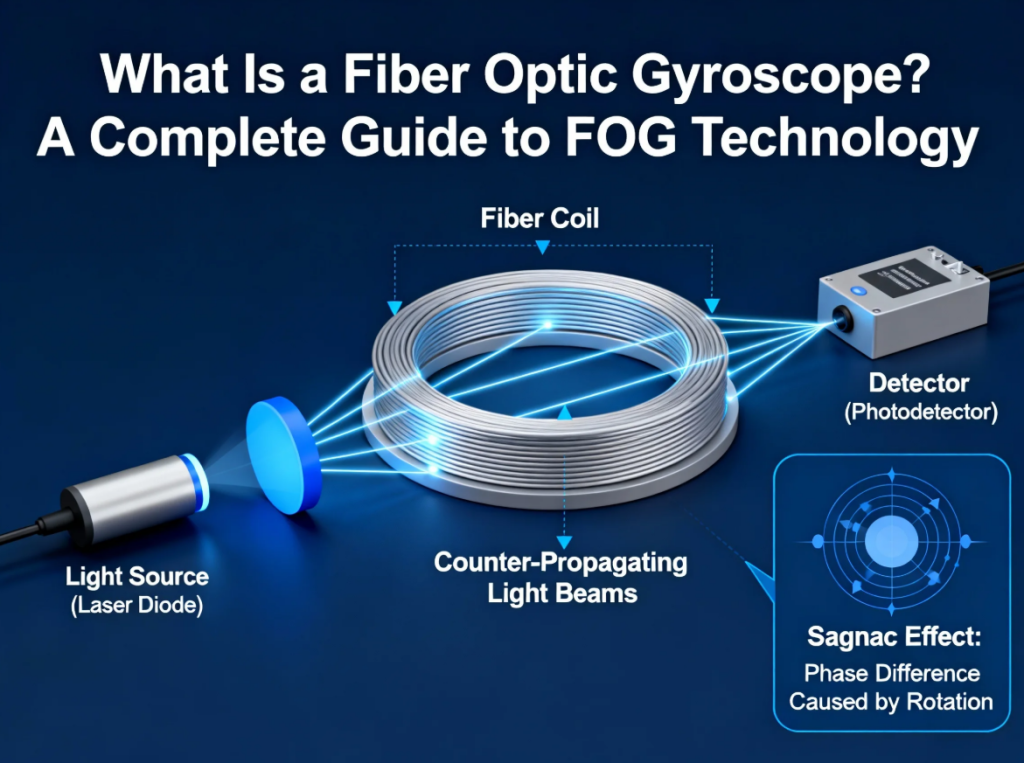
Fiber optic gyroscopes operate based on the Sagnac effect—a physical phenomenon where two light beams traveling in opposite directions inside a coil of optical fiber experience a phase difference when the system rotates.
Here’s the basic process:
- A light source (typically a superluminescent diode) splits into two beams.
- The beams travel in opposite directions through long coils of optical fiber.
- When rotation occurs, the effective path length of one beam becomes longer.
- This creates a measurable phase shift, which the system converts into a precise rotation rate.
Because the measurement is entirely optical, FOGs deliver ultra-high sensitivity, fast response, and excellent bias stability.
Key Advantages of Fiber Optic Gyroscopes
Fiber optic gyroscopes are popular in high-performance applications because they offer several significant benefits:
1. No Moving Parts for Higher Reliability
The fully solid-state design ensures:
- High reliability
- Long operational life
- Minimal maintenance
2. Excellent Bias Stability
FOGs provide stable measurements even in harsh environments, making them suitable for long-duration missions.
3. High Accuracy and Bias Sensitivity
They can detect extremely small rotation rates, making them ideal for precise navigation systems.
4. Strong Resistance to Shock and Vibration
Unlike mechanical gyros, FOGs maintain accuracy even under intense physical stress.
5. Wide Dynamic Range
FOGs can accurately sense both low and high rotation speeds.
Common Applications of Fiber Optic Gyroscopes
FOGs are widely used across multiple industries where stable and accurate rotation data is critical:
1. Aerospace & Aviation
- Inertial navigation systems (INS)
- Aircraft attitude control
- UAV/Drone stabilization
2. Marine & Underwater Navigation
- Submarine navigation
- Ship heading control
- Autonomous underwater vehicle (AUV) guidance
3. Defense & Military
- Missile guidance
- Tank stabilization
- Tactical-grade positioning systems
4. Industrial & Robotics
- Autonomous vehicle navigation
- Precision machining and motion control
- Robot orientation sensing
5. Surveying & Geospatial
- Fiber optic gyro compasses
- Mobile mapping systems
Explore industry-specific solutions:
→https://hxgyro.com/solutions/
FOG vs. MEMS Gyroscope: What’s the Difference?
| Feature | Fiber Optic Gyroscope | MEMS Gyroscope |
|---|---|---|
| Accuracy | Very high | Moderate |
| Stability | Excellent | Medium |
| Cost | Higher | Lower |
| Size | Larger | Very compact |
| Best Use Cases | Aerospace, defense, marine, high-end navigation | Consumer electronics, automotive, mid-level navigation |
FOGs are preferred when top-tier precision and stability are required, while MEMS gyroscopes are chosen for cost-sensitive, compact applications.
Why Fiber Optic Gyroscopes Matter Today
As industries move toward autonomous systems, advanced robotics, and intelligent transportation, the demand for reliable navigation sensors continues to grow. Fiber optic gyroscopes provide the accuracy and robustness needed for these next-generation technologies—ensuring stable positioning, smooth motion control, and mission success in challenging environments.
Conclusion
A fiber optic gyroscope is a high-performance rotation sensor that uses light instead of mechanical components to measure angular velocity. With its superior stability, precision, and ruggedness, FOG technology has become essential in aerospace, marine, defense, robotics, and industrial navigation systems.
Whether you’re designing a navigation platform or exploring advanced sensing technologies, understanding fiber optic gyroscopes is crucial for building reliable, accurate, and future-ready systems.
★ CTA: Build Your Next-Generation Navigation System with HXGYRO
Upgrade your project with high-precision fiber optic gyroscopes from HXGYRO.
√ Explore INS / IMU Products
→ https://hxgyro.com/product-category/imu/
→ https://hxgyro.com/product-category/ins/
√ Contact Our Engineering Team
Your high-precision navigation solution starts here.